
Low fiber foods: the full list, with grams per serving
Low fiber foods fall into two groups: things with literally zero — meat, fish, eggs, dairy, oils, most cheese — and refined plant foods that keep only traces, like white bread, white rice, and juice. Fiber exists only in plants, and milling, peeling, and juicing strip most of it out.
Foods with no fiber at all
Fiber is the collection of plant carbohydrates the small intestine can't break down. Animal tissue isn't built from those carbohydrates, so no animal food contains any. These are true zeros, not roundings:
- Beef, pork, lamb, chicken, turkey — every cut, however it's cooked
- Fish and shellfish, fresh or canned
- Eggs, whole or whites
- Milk, cream, plain yogurt, butter
- Cheese of every kind — cheddar, mozzarella, parmesan, cottage, cream cheese
- Cooking fats: olive oil, canola, coconut oil, lard, ghee
- Table sugar, honey, maple syrup
- Clear broth, coffee, tea, most spirits
The shortcut for foods with no fiber: if it walked, swam, or was rendered from something that did, it has none. That's why steak, eggs, and buttered white toast come to well under a gram — the toast is doing all the work.
Two things break the rule quietly. Breaded or battered proteins carry the flour's fiber, though a coated fillet adds maybe half a gram. And flavored yogurts pick up whatever the fruit puree or granola brings with it.
Near-zero low fiber foods that look like real servings
The bigger surprise isn't the zeros. It's the refined plant foods that read as "a serving of something." Milling wheat into white flour removes the bran, where nearly all the fiber sat. Juicing an orange leaves the fiber in the pulp bin.
| Food | Typical serving | Fiber |
|---|---|---|
| White bread | 1 slice | ~0.7 g |
| White rice, cooked | 1 cup | ~0.6 g |
| Cornflakes | 1 cup | ~1 g |
| Saltine crackers | 5 crackers | ~0.4 g |
| Orange juice, no pulp | 1 cup | ~0.5 g |
| Apple juice | 1 cup | ~0.5 g |
| Iceberg lettuce, shredded | 1 cup | ~0.7 g |
| Cucumber, peeled | ½ cup | ~0.3 g |
| Baked potato, flesh only | 1 medium | ~2.3 g |
| Pasta, white, cooked | 1 cup | ~2.5 g |
Pasta is the honest outlier: white semolina pasta carries more fiber than white rice or white bread, somewhere around 2 to 2.5 grams a cup cooked. And a baked potato roughly doubles when the skin goes with it, since the skin holds most of the fiber. Peeling is a bigger decision than it looks.
Low fiber vegetables
Vegetables aren't automatically a fiber source. The watery, pale ones sit near the bottom of the range:
- Iceberg lettuce: about 0.7 g per cup shredded
- Peeled cucumber: about 0.3 g per half cup
- Raw mushrooms: about 0.4 g per half cup sliced
- Celery: roughly 0.6 g per medium stalk
- Zucchini, cooked and peeled: about 1 g per half cup
- Tomato: about 1.5 g for a medium one
A generous salad of iceberg, cucumber, and tomato with a creamy dressing can total 2 grams. Romaine instead of iceberg helps a little; beans, seeds, or avocado on top change the number several times over. The high fiber foods list covers what actually moves it.
Low fiber fruits and juices
Whole fruit usually beats vegetables per serving, but the low fiber fruits are the ones people eat in volume:
- Watermelon: about 0.6 g per cup diced
- Cantaloupe: about 1.4 g per cup cubed
- Grapes: roughly 1.4 g per cup
- Canned peaches in juice: about 1.5 g per half cup
- Any juice without pulp: under 1 g per cup
The gap between a fruit and its juice is the clearest case in the category. A medium orange runs about 3 grams; a cup of orange juice, half a gram — and that cup took two or three oranges to fill.
How an ordinary day lands under 10 grams
Nobody plans this. The arithmetic just works out:
- Coffee with cream, two scrambled eggs: 0 g
- Orange juice: 0.5 g
- Turkey sandwich on white, iceberg and mayo: 2 g
- Potato chips: 1.5 g
- Chicken breast, white rice, peeled zucchini: 2 g
- Ice cream: 0.5 g
That's roughly 6.5 grams from a day that included juice, salad, and a cooked vegetable. Add a whole apple and it's still under 11.
For scale, the Adequate Intake set by the National Academies is 25 grams a day for adult women and 38 for adult men through age 50, dropping to 21 and 30 after that, and the FDA's Daily Value on the Nutrition Facts label is 28 grams. U.S. dietary surveys have consistently found average adult intake falling well short of those figures. The targets themselves are broken down in daily fiber intake.
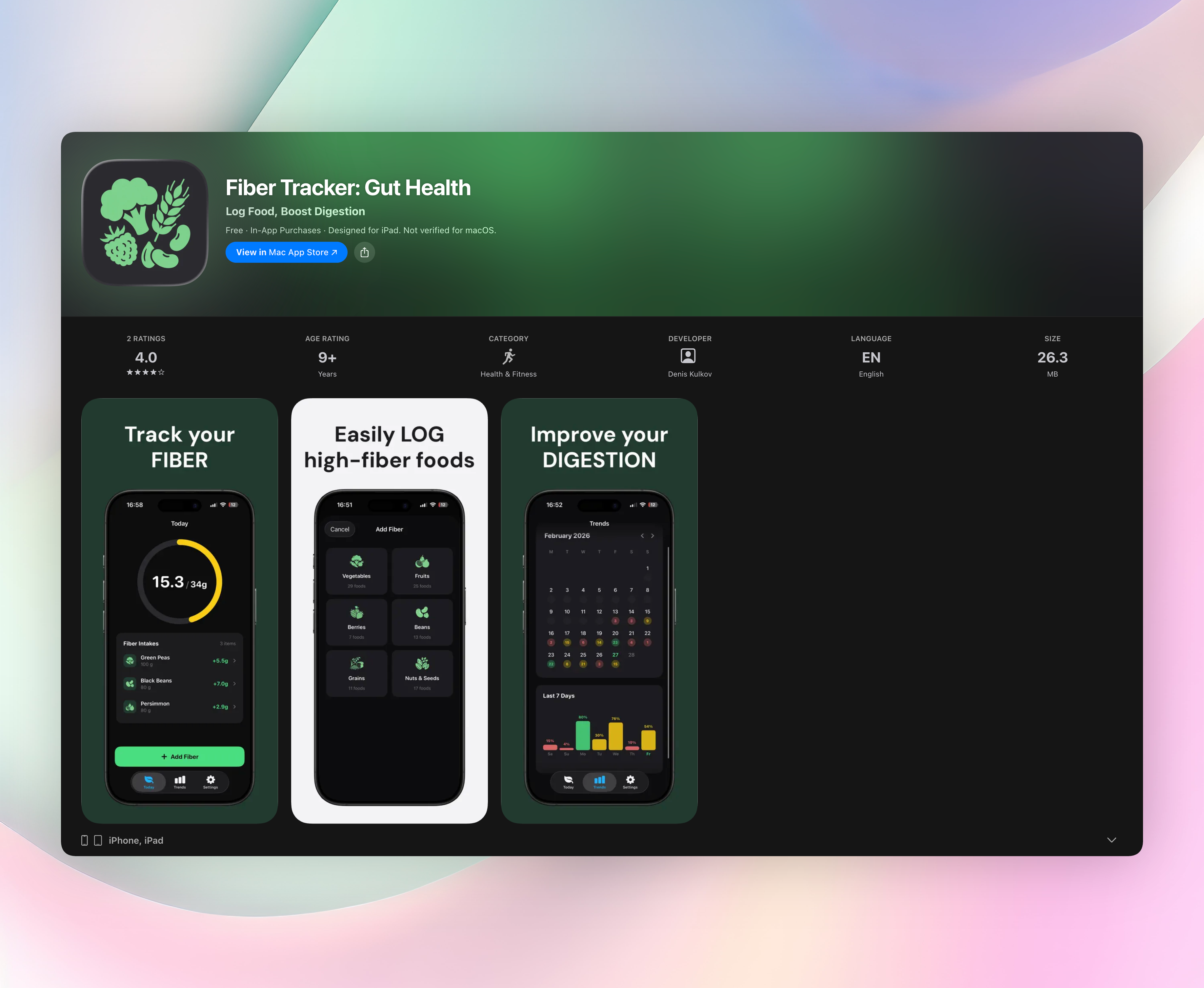
Meal by meal the pattern is invisible; across a whole day it's obvious. Logging a few typical days in Fiber Tracker, a fiber tracking app for iPhone, puts the zeros and the near-zeros next to each other on one screen instead of on eight separate labels.
When a low fiber diet is deliberate
Clinicians sometimes direct a short low-residue plan, generally described in published protocols as capping fiber somewhere near 10 to 15 grams a day. Documented uses include the day or two before a colonoscopy, recovery after certain bowel surgeries, flares of some inflammatory bowel conditions, and narrowed intestinal segments where bulky residue causes trouble.
The specifics vary by institution. Some protocols also restrict nuts, seeds, and skins; others handle dairy separately; the reintroduction schedule differs everywhere. These are short-term plans with a defined endpoint set by a clinician, not a general way of eating. Anyone following one is working from their care team's list rather than a general article — though the food groupings above run in reverse for it, with the zeros becoming the staples.
FAQ
What foods have no fiber?
Every animal food — meat, poultry, fish, shellfish, eggs, milk, cheese, plain yogurt — plus oils, butter, sugar, honey, and clear broths. Fiber comes only from plants, so anything containing no plant material has zero grams. Coffee, tea, and most spirits are fiber-free too.
Is white rice a low fiber food?
Yes. A cooked cup holds roughly 0.6 grams, because milling strips the bran and germ. Brown rice keeps both and lands closer to 3 to 3.5 grams a cup. The entire difference is in the layers that get polished off.
Are eggs and cheese low in fiber or actually zero?
Zero, in every preparation. A label showing a small number is reflecting an added ingredient — a coating, a starch, a stabilizer, or fruit stirred into a yogurt or cheese product.
Does blending or cooking destroy fiber?
No. Blending breaks fiber into smaller pieces but keeps all of it in the glass, which is why a smoothie is not a juice. Juicing removes it with the pulp. Cooking softens fiber and can move some soluble fiber into the cooking water, but it doesn't eliminate it — soluble and insoluble fiber respond to heat and water differently.
How many grams counts as a low fiber diet?
Clinical protocols generally sit near 10 to 15 grams a day, against an Adequate Intake of 25 to 38 grams for adults under 51. Days that land in the same range unintentionally are common, and they happen without anyone restricting a single food.
Free Fiber tools
- Bristol Stool ChartCompare your stool with the seven-point Bristol bowel movement chart to see what the form indicates about gut transit time and general dietary levers.
- Carrot Fiber CalculatorEstimate the fiber in carrots by entering an amount, carrot size or weight, and whether they are raw or cooked.
- Daily Fiber CalculatorEstimate how much fiber each day fits your age, sex and life stage. See the personal target beside the FDA Daily Value used on nutrition labels.
- Fiber for Weight Loss CalculatorUse your calorie target or estimate one from your body measurements and activity. Get a daily fiber target and a gradual ramp-up schedule.
- Fruit Fiber ChartChoose a fruit, enter its serving size and compare fiber grams with other fruits from the same list.
- Fiber Ramp-Up PlannerWondering how much is too much fiber? Enter your current and target intake to get a week-by-week ramp-up schedule with matching fluid context.
- High Fiber Foods ChartUse this high-fiber foods chart for constipation to compare plant foods by category and sort them by fiber per 100 g or typical serving.
- High-Fiber Meal Plan BuilderChoose a daily fiber target, number of meals and food preference to create a one-day combination with fiber per meal and progress toward your target.
- Prune and Prune Juice Fiber CalculatorEstimate how much fiber and approximate sorbitol you get from prunes or prune juice, including how much prune juice for constipation questions may miss: juice has much less fiber than whole prunes.
- Soluble vs Insoluble Fiber ChartCompare soluble and insoluble fiber values by food and serving size for Fiber Tracker logging.
- Sweet Potato Fiber CalculatorEstimate how much fiber in a sweet potato based on its weight, cooking method and whether you eat the skin. See fibre, calories, carbs and daily target share.