
30 grams of fiber a day, and how to count it right
30 grams of fiber a day is a round target that sits between the two U.S. adequate intakes — 25 g for women, 38 g for men — and just above the FDA's 28 g Daily Value used on labels. It's a number to aim at, not a line you fail below.
Where the 30 grams of fiber a day figure comes from
Three bodies, three numbers.
The National Academies set fiber as an Adequate Intake rather than an RDA, pegged to energy: 14 g of fiber per 1,000 calories. Applied to typical calorie needs, that's 25 g a day for women aged 19–50 and 38 g for men. Both drop after 50, to 21 g and 30 g, as calorie needs fall.
The FDA uses one figure for labeling. The fiber daily value is 28 g, based on a 2,000-calorie reference diet, and it's what every %DV on a package is calculated from.
Outside the U.S., the UK's advisory committee recommends 30 g a day for adults, and EFSA treats 25 g as adequate for normal bowel function. If you want a single fiber goal per day, 30 g is defensible in all three systems. For the age and sex breakdown, see how much fiber per day.
| Source | Figure | Basis |
|---|---|---|
| National Academies (AI) | 25 g women, 38 g men, ages 19–50 | 14 g per 1,000 calories |
| FDA Daily Value | 28 g | 2,000-calorie label reference |
| UK (SACN) | 30 g | adults |
| EFSA | 25 g | adults, bowel function |
How to read fiber off a nutrition label
On a U.S. Nutrition Facts panel, Dietary Fiber is indented under Total Carbohydrate, in grams, with a %DV beside it.
Use the %DV shortcut: FDA's general rule is that 5% DV or less per serving is low and 20% or more is high. Since the daily value is 28 g, multiply any %DV by 0.28 to get grams — 20% DV is 5.6 g.
Then check the serving size, because every number on the panel is per serving, and the package serving is usually smaller than what's in your bowl. If the label breaks out Soluble Fiber or Insoluble Fiber, those are subsets of the Dietary Fiber line, not additions; soluble vs insoluble fiber covers what the split means. UK and EU labels work differently — fibre appears per 100 g, with no %DV column.
Does fiber count as carbs?
On a U.S. label, yes. Fiber is a carbohydrate by chemistry, so its grams sit inside the Total Carbohydrate number rather than on top of it. It just doesn't act like starch or sugar — humans lack the enzymes to break most of it down.
That's the logic behind net carbs. The term isn't FDA-defined and there's no legal formula, but the common version is total carbohydrate minus dietary fiber minus sugar alcohols. The net carbs fiber subtraction only makes sense on a U.S.-style label — on a UK or EU label the declared carbohydrate figure already excludes fibre, so subtracting it again counts it twice.
Three ways people miscount fiber
Trusting per-100 g figures for a 40 g serving
Databases and European labels quote per 100 g, which makes cereals and crispbreads look enormous. A cereal listing 25 g of fiber per 100 g gives you 10 g in a 40 g bowl. Weigh the portion or convert it.
Double-counting added fiber
Chicory root fiber, inulin, and similar isolated fibers go into bars, yogurts, and low-carb baked goods. When the front of a package flags "prebiotic fiber," those grams are already inside the Dietary Fiber line on the back — the claim isn't extra fiber. Supplements hit the same trap: psyllium stirred into a smoothie counts once, not twice.
Ignoring cooked versus dry weight
Grains and legumes absorb a lot of water as they cook, which dilutes fiber per gram. Dry lentils and beans typically run about two to three times denser in fiber, gram for gram, than the same food cooked; oats, rice, and pasta dilute by a smaller but still real margin. Log the state you ate it in: "cooked" if you weighed after the pot, "dry" if you measured before.
A daily method for tracking fiber
Precision past the nearest gram is wasted effort. Three steps.
- Log by portion. "One pear," "half a cup of black beans," "two slices of rye." Estimate the grams for a food once, then reuse that figure.
- Check the total at dinner. That's the last point where you can still move the number; checking at bedtime just reports it.
- Adjust the last meal. A cup of beans or a serving of berries moves a day by several grams, and high-fiber foods are mostly ordinary groceries.
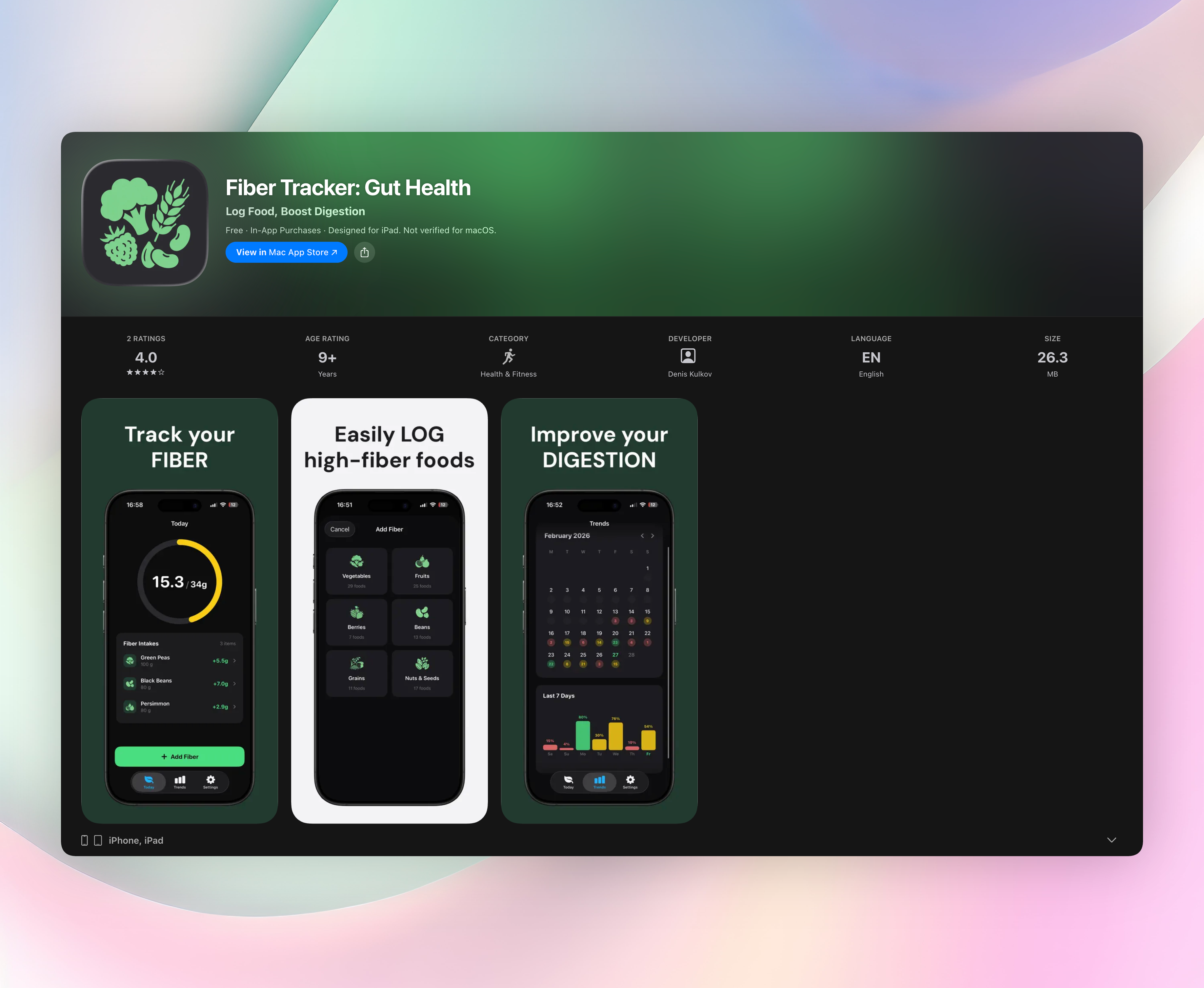
The running total is the part people abandon, since it's arithmetic across six or seven entries a day. Fiber Tracker is a fiber tracking app for iPhone that holds that total for you, so the only decision left is what to log.
FAQ
How do I track fiber intake without weighing every meal?
Weigh a few staples once — oats, rice, beans, bread — and note the grams in the portion you actually serve. After that you're recalling numbers, not measuring. Packaged foods come off the label; whole fruits and vegetables are close enough by piece.
How much fiber per 1,000 calories should I get?
The Adequate Intake works out to 14 g per 1,000 calories, so a bigger eater ends up with a higher target: about 22 g at 1,600 calories, roughly 36 g at 2,600.
Is 30 g a day too much fiber?
It sits within published guidelines for adults: below the 38 g adequate intake for men aged 19–50, and only slightly above the 28 g Daily Value. No upper limit has been set for fiber from food.
What happens if I jump from 15 g to 30 g in one day?
Gas, bloating, and cramping are the usual complaints when intake rises fast. Common guidance is to add about 5 g a week, with more fluid alongside, giving gut bacteria time to adjust.
Free Fiber tools
- Bristol Stool ChartCompare your stool with the seven-point Bristol bowel movement chart to see what the form indicates about gut transit time and general dietary levers.
- Carrot Fiber CalculatorEstimate the fiber in carrots by entering an amount, carrot size or weight, and whether they are raw or cooked.
- Daily Fiber CalculatorEstimate how much fiber each day fits your age, sex and life stage. See the personal target beside the FDA Daily Value used on nutrition labels.
- Fiber for Weight Loss CalculatorUse your calorie target or estimate one from your body measurements and activity. Get a daily fiber target and a gradual ramp-up schedule.
- Fruit Fiber ChartChoose a fruit, enter its serving size and compare fiber grams with other fruits from the same list.
- Fiber Ramp-Up PlannerWondering how much is too much fiber? Enter your current and target intake to get a week-by-week ramp-up schedule with matching fluid context.
- High Fiber Foods ChartUse this high-fiber foods chart for constipation to compare plant foods by category and sort them by fiber per 100 g or typical serving.
- High-Fiber Meal Plan BuilderChoose a daily fiber target, number of meals and food preference to create a one-day combination with fiber per meal and progress toward your target.
- Prune and Prune Juice Fiber CalculatorEstimate how much fiber and approximate sorbitol you get from prunes or prune juice, including how much prune juice for constipation questions may miss: juice has much less fiber than whole prunes.
- Soluble vs Insoluble Fiber ChartCompare soluble and insoluble fiber values by food and serving size for Fiber Tracker logging.
- Sweet Potato Fiber CalculatorEstimate how much fiber in a sweet potato based on its weight, cooking method and whether you eat the skin. See fibre, calories, carbs and daily target share.