
Too much fiber: symptoms, the real limit, and how to fix it
There's no official upper limit for fiber, so no single number defines too much fiber. In practice, symptoms cluster above roughly 50–70 grams a day — and at any intake reached too fast. Gas, bloating, and cramping are the usual signs.
Can you eat too much fiber?
Yes, but not the way you can overdo vitamin A or sodium. Fiber isn't absorbed, so toxicity isn't the issue. The National Academies set an Adequate Intake for total fiber — 14 grams per 1,000 calories, roughly 38 a day for men and 25 for women under 50, dropping to 30 and 21 after — but set no Tolerable Upper Intake Level, since no threshold made fiber harmful. The FDA's Daily Value on nutrition labels is 28 grams.
What exists instead is a tolerance ceiling, and it's personal: how much fermentable fiber the colon handles at once, and how fast it got there. Most people asking this have hit the second one.
Too much fiber symptoms
Complaints arrive in a fairly predictable order as intake climbs:
- Gas. The first sign, and it shows up at the lowest intakes.
- Bloating and visible distension. Gas volume plus a fuller, slower colon.
- Cramping. Often lower left, a few hours after a large legume-heavy meal.
- Loose, urgent stools. Insoluble fiber speeds transit; excess gel-forming fiber holds water.
- Constipation that worsens instead of improving. Bulk without enough fluid makes a firmer stool — the opposite of what more fiber was supposed to do.
- Early fullness. Fiber displaces calories, which matters when intake is already marginal.
- Reduced mineral absorption. Only at sustained very high intakes, driven more by phytate in bran and legumes than by fiber itself, which binds iron, zinc, and calcium.
That's over-reported: at intakes from a normal whole-food diet it's not a practical concern, and soaking, sprouting, fermenting, and cooking all cut phytate.
Is 50 grams of fiber too much?
Not automatically. Populations whose staples are legumes, tubers, and whole grains eat at that level without complaint, because they always have. Fifty grams landing on a gut used to 15 is a different event.
The number that predicts symptoms is the change, not the total. Raising intake faster than about 5 grams a week is where most people start noticing something, regardless of starting point. Someone going 20 to 45 grams in a week will feel it; arriving at 45 over two months usually won't. For setting a target in the first place, how much fiber per day covers it.
Does fiber cause gas?
Some kinds do, and the split matters more than any other distinction here. Fermentable fibers — inulin and chicory root, fructooligosaccharides, galactooligosaccharides in beans, beta-glucan, pectin, resistant starch — feed colonic bacteria, which ferment them into short-chain fatty acids (the benefit) plus hydrogen, carbon dioxide, and in some people methane (the gas).
Poorly fermented fibers do almost none of that — wheat bran and cellulose pass through largely intact. Psyllium gels and bulks but resists fermentation, adding stool volume without inulin's output. Fermentability predicts symptoms better than the soluble vs insoluble fiber split does.
How long does fiber bloating last?
There are two clocks.
After a single high-fiber meal. Fermentation happens in the colon, so gas peaks roughly 4 to 12 hours after eating, not immediately, and clears within a day.
After a sustained increase. Adaptation typically takes one to three weeks, as gut bacteria shift toward species that handle the new substrate, including hydrogen-consumers that clear gas instead of producing it. Symptoms should trend down across that window, not sit flat.
If fiber bloating hasn't improved at all after three or four weeks at a steady intake, adaptation isn't the explanation.
Adaptation or intolerance?
| Sign | Adaptation | Intolerance |
|---|---|---|
| Trend over 2–3 weeks | Steadily improving | Flat or worse |
| Trigger | Any large increase | Specific foods, even in small amounts |
| Onset | Began when intake rose | Predates the change, or unrelated to it |
| After backing off 5–10 g | Settles, then tolerates more on retry | Settles, then returns at the same dose |
| Other symptoms | Gas, bloating, cramping | Plus pain, blood, or weight loss |
The right-hand column — blood, unintended weight loss, or pain that wakes someone at night — sits outside what a fiber adjustment addresses; clinicians evaluate those separately.
Backing off without quitting fiber
Reducing beats stopping — cutting fiber to near zero clears symptoms but teaches nothing, and the cycle repeats on the way back up. The standard adjustment:
- A 5–10 gram reduction from current intake, held one to two weeks — enough for symptoms to settle without losing the adaptation already built.
- A rebuild of about 5 grams a week, slower if symptoms return.
- Fluid matched to bulk. Gel-forming and bulking fibers need water; without it they harden stool instead of softening it — psyllium especially.
- A temporary swap of fermentable for bulk fiber. Less chicory root, inulin, beans, onion, and garlic; more psyllium, oats, and cooked produce, adding items back one at a time.
- Spreading the load and checking labels. Three meals at 10 grams beats one at 30; isolated fibers like chicory root and inulin get added to bars, yogurts, and protein products and stack up unnoticed.
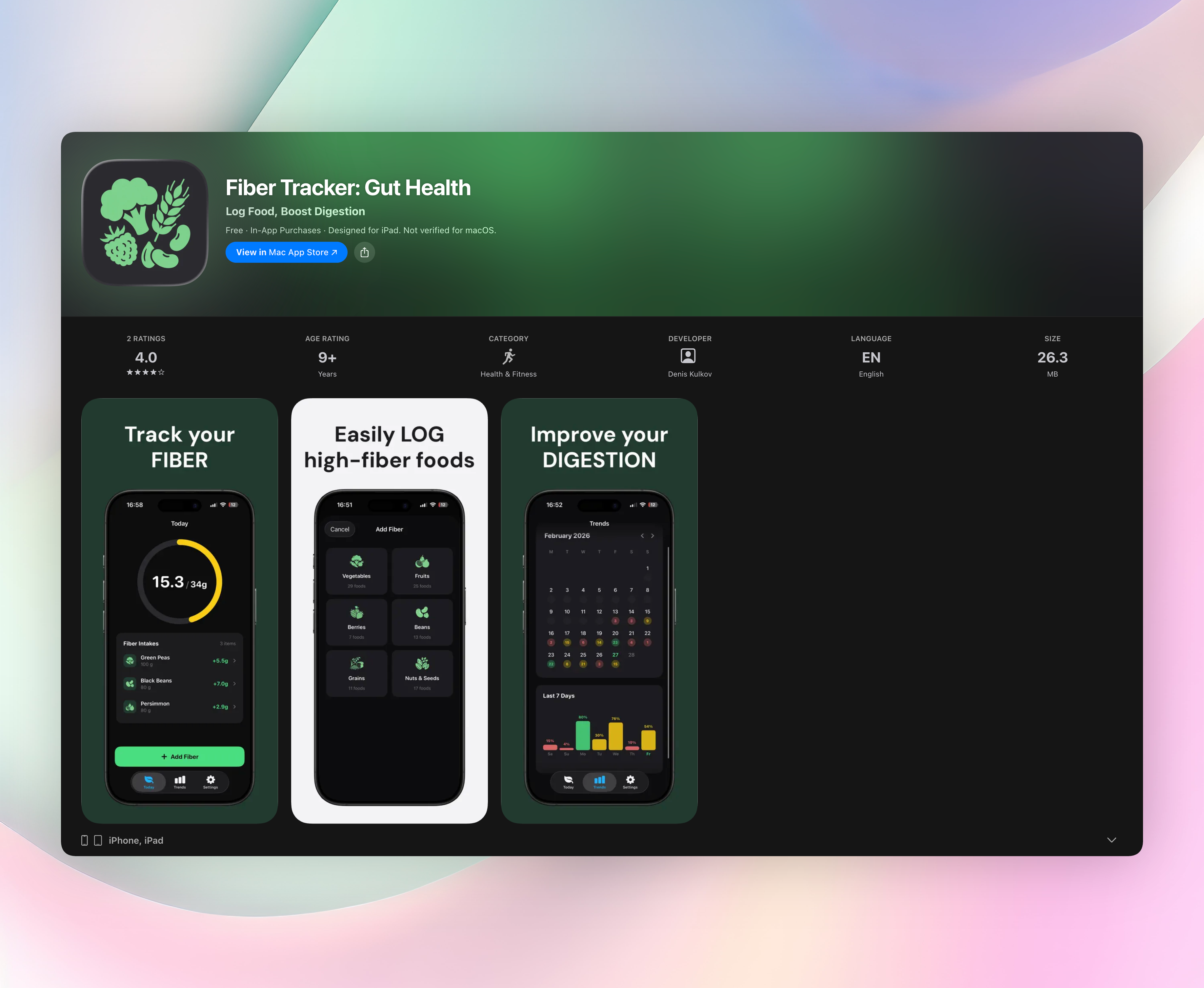
All of that assumes a known starting number, since "less fiber" isn't a dose. Fiber Tracker is a fiber tracking app for iPhone, which turns the daily total into something adjustable rather than guessed at.
The paradoxical-constipation case is its own pattern, and the fix there is usually fluid and fiber type rather than a smaller total — fiber and constipation goes through it.
FAQ
How much fiber is too much in a day?
No guideline sets a ceiling — the DRI includes no Tolerable Upper Intake Level for fiber. Symptom reports become common above roughly 50 to 70 grams a day, though some tolerate more and others struggle below that; the intake that produces symptoms is the practical limit.
Why does fiber cause bloating when the rest of the diet hasn't changed?
Usually the type shifted, not the amount. Beans, onions, chicory root, or an inulin supplement raise the fermentable share sharply even when the gram total barely moves.
Can too much fiber cause constipation?
Yes. Bulking fiber without enough fluid produces a larger, drier stool that's harder to pass — the same happens in slow-transit constipation, where added bulk sits in a colon that isn't moving it along.
Does bloating from fiber mean weight gain?
No. Distension from gas and a fuller colon is volume, and it fluctuates over hours. Fiber contributes few or no usable calories, since the body doesn't digest it.
Is stopping fiber the answer when symptoms appear?
Published guidance points the other way — the Adequate Intake runs 21 to 38 grams for adults depending on age and sex, and average US intake falls short of it. Dropping to a tolerated level and rebuilding slowly preserves the target while the gut adapts.
Free Fiber tools
- Bristol Stool ChartCompare your stool with the seven-point Bristol bowel movement chart to see what the form indicates about gut transit time and general dietary levers.
- Carrot Fiber CalculatorEstimate the fiber in carrots by entering an amount, carrot size or weight, and whether they are raw or cooked.
- Daily Fiber CalculatorEstimate how much fiber each day fits your age, sex and life stage. See the personal target beside the FDA Daily Value used on nutrition labels.
- Fiber for Weight Loss CalculatorUse your calorie target or estimate one from your body measurements and activity. Get a daily fiber target and a gradual ramp-up schedule.
- Fruit Fiber ChartChoose a fruit, enter its serving size and compare fiber grams with other fruits from the same list.
- Fiber Ramp-Up PlannerWondering how much is too much fiber? Enter your current and target intake to get a week-by-week ramp-up schedule with matching fluid context.
- High Fiber Foods ChartUse this high-fiber foods chart for constipation to compare plant foods by category and sort them by fiber per 100 g or typical serving.
- High-Fiber Meal Plan BuilderChoose a daily fiber target, number of meals and food preference to create a one-day combination with fiber per meal and progress toward your target.
- Prune and Prune Juice Fiber CalculatorEstimate how much fiber and approximate sorbitol you get from prunes or prune juice, including how much prune juice for constipation questions may miss: juice has much less fiber than whole prunes.
- Soluble vs Insoluble Fiber ChartCompare soluble and insoluble fiber values by food and serving size for Fiber Tracker logging.
- Sweet Potato Fiber CalculatorEstimate how much fiber in a sweet potato based on its weight, cooking method and whether you eat the skin. See fibre, calories, carbs and daily target share.