
How much psyllium husk per day: dosage, water, and timing
How much psyllium husk per day comes down to the label: about a teaspoon of whole husk (~5 g) per dose, one to three times daily, each with a full glass of water. That's roughly 4–12 g of fiber — a slice of a 25–38 g day, not a replacement for it.
How much psyllium husk per day the label directs
Psyllium husk dosage is defined by the product rather than by a universal number, but directions almost always take the same shape: begin with one dose a day, take no more than three, and put at least 8 ounces of liquid behind each one.
The ramp matters more than the ceiling. Jumping from nothing to three doses on day one is the reliable way to earn bloating and cramping, because transit time and the bacteria along the way are both adjusting to a new water-holding load. Stretching that adjustment across a couple of weeks — one dose daily in week one, a second in week two, a third only if the label permits it and the first two aren't doing the job — is the pattern most manufacturers put in the fine print.
One published number is worth carrying around. The FDA's authorized health claim for soluble fiber from psyllium seed husk and coronary heart disease is built on 7 grams a day of soluble fiber from psyllium, divided into servings supplying at least 1.7 grams each. Psyllium husk is roughly 70% soluble fiber, so 7 grams of soluble fiber works out to something near 10 grams of husk daily — about two teaspoons. That is the top of the usual dosing range, not the entry point.
What a teaspoon actually delivers
A level-to-rounded teaspoon of whole psyllium husk weighs in the neighborhood of 5 grams and carries about 4 grams of fiber. Set that against the Adequate Intake figures used on US nutrition guidance — 25 g a day for adult women and 38 g for adult men under 51, with lower figures after that, and a 28 g Daily Value on labels — and a single scoop covers roughly a tenth to a sixth of the day. Three scoops still leave most of the target to food. If the daily number itself is fuzzy, the daily fiber intake targets are the place to start.
Density is where the math quietly breaks. Whole husk is flaky and light; milled psyllium powder packs more grams into the same spoon, so identical teaspoons of two products can differ by a gram or more of fiber. The serving size on the panel is in grams for a reason, and a scale settles it faster than any spoon comparison.
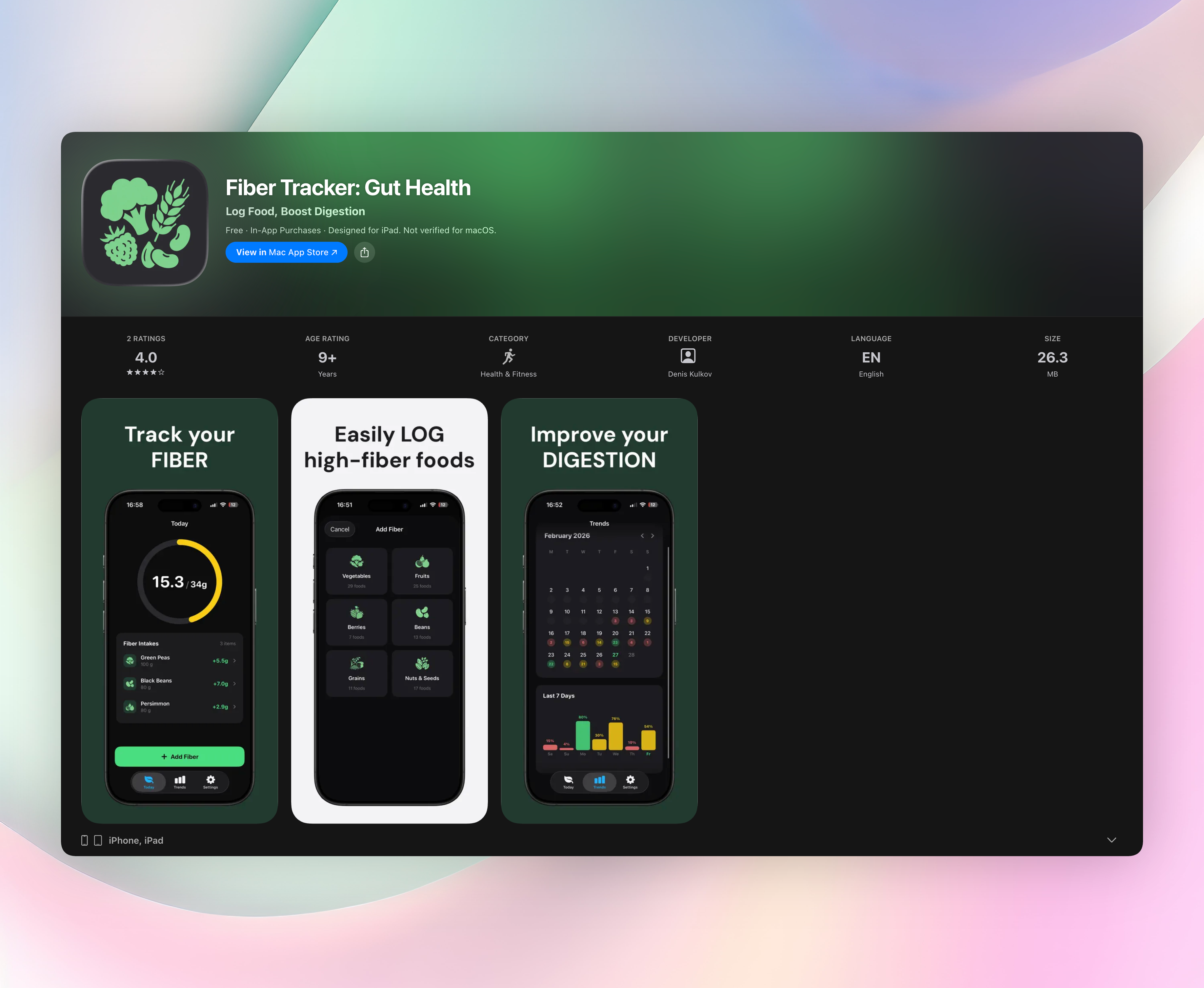
Logging the supplement in the same place as the food makes the comparison concrete instead of theoretical — Fiber Tracker is a fiber tracking app for iPhone, and the exercise works on paper too. Seeing 4 grams from the scoop sitting under 15 grams from a cup of lentils tends to end the argument about whether a supplement can carry a day.
How to take psyllium husk without the usual mistakes
Water is not a suggestion. Every dose is meant to go down with at least 8 ounces of liquid, and US bulk-laxative labels carry an FDA-mandated warning: taken without enough fluid, the product may swell and block the throat or esophagus and cause choking, and it isn't for anyone who has difficulty swallowing. Gelling is the entire mechanism — it belongs in the glass and the stomach, with water to spare.
The mechanics that make it tolerable are simple. Stir into a full glass, drink it promptly before it stiffens toward pudding, then follow with a second glass of plain water. Milled powder thickens faster than whole husk, which is why powder users complain about texture more often. Mixed into yogurt or oatmeal instead, the fluid requirement still stands.
Spacing is the other half of how to take psyllium husk properly. A gel that slows gastric emptying can also slow or reduce absorption of some medications, so labels direct taking other medicines at least two hours before or two hours after a dose. For narrow-margin drugs — thyroid hormone, lithium, certain diabetes medications, carbamazepine, digoxin — a pharmacist can check the specific product rather than a general rule.
Best time to take fiber, and whether it matters
For regularity, the best time to take fiber is whenever the dose actually happens every day; consistency beats clock time, and psyllium's effect on stool form builds over days rather than hours. For blood sugar or appetite, taking it shortly before a meal has the clearer rationale, since the gel slows gastric emptying and the rate at which carbohydrate reaches the small intestine.
There's a practical argument for keeping doses away from large meals: a viscous gel on top of a full plate is uncomfortable for some people, and splitting doses spreads both the volume and the water requirement across the day. If the goal is relief from constipation, evening dosing is common simply because it fits the routine, not because the timing has special properties.
Psyllium husk vs Metamucil, capsules, and store brands
Psyllium husk vs Metamucil isn't really an ingredient question — Metamucil's active ingredient is psyllium husk. What differs is what rides along with it and how much fiber each serving contains.
| Form | Typical single dose | Fiber per dose | What you're paying for |
|---|---|---|---|
| Whole psyllium husk | ~1 tsp (about 5 g) | ~4 g | The raw ingredient; coarse texture, gels slowly |
| Milled psyllium powder | ~1 tsp, denser | Read the label — often more per spoon | Faster mixing, faster thickening |
| Flavored blends (Metamucil and similar) | 1 rounded tsp or tbsp per label | Around 3 g per serving | Flavor, sweetener, color, and dosing convenience |
| Capsules | Commonly 5 capsules (~0.5 g each) | ~2 g | Portability; the slowest route to a gram target |
| Store-brand psyllium husk | Matches the branded equivalent | Matches | The same ingredient, less brand |
Two things follow. Flavored blends dilute the fiber — a sizable share of the scoop is sweetener or flavoring, so per-serving fiber lands below what plain husk gives for the same weight. Capsules are the least gram-efficient form by a wide margin: a teaspoon's worth means swallowing five or six, three times over at the higher end of the range.
Store brands of plain psyllium husk are the same ingredient as the name brands. Price gaps between them reflect branding and format, not fiber quality.
Do fiber supplements work as well as food?
For the narrow jobs, they work. Psyllium is a gel-forming, poorly fermented fiber, which is why it holds water in stool and normalizes stool form in both directions — it firms loose stool and softens hard stool. It also has the best-supported case among fiber supplements for modest LDL cholesterol reduction and blunted post-meal glucose.
What a supplement can't do is stand in for the mix. Psyllium is one fiber type; beans, oats, berries, and vegetables bring several at once, plus the minerals, polyphenols, and resistant starch that ride along with them. The distinction between soluble and insoluble fiber is exactly why a single supplement covers part of the job — a psyllium habit closes a gap in a food-first day, and gets expensive and unpleasant if asked to do the whole thing.
FAQ
How much psyllium husk should someone start with?
Labels typically direct one dose a day to begin — around a teaspoon of whole husk, roughly 5 g, delivering about 4 g of fiber. Directions generally allow building to a maximum of three doses a day over a week or two. The escalation is what's usually skipped, and it's the part that prevents most of the gas and cramping complaints.
Can psyllium husk be taken every day?
Bulk-forming fiber is labeled for daily use, and daily dosing is how the cholesterol and stool-form effects are studied. It doesn't create dependence the way stimulant laxatives can. Labels do direct anyone whose symptoms persist beyond a week to consult a doctor.
How long does psyllium husk take to work?
For stool changes, labels generally say 12 to 72 hours, and effects on stool form tend to settle after several consistent days rather than after one dose. Cholesterol and glucose effects are measured over weeks of daily use, not single servings.
Is psyllium husk the same as Metamucil?
Metamucil's active ingredient is psyllium husk, so the fiber is the same. The differences are the added sweetener, flavor, and color, the resulting fiber-per-serving figure, and the price per gram of actual fiber. Plain psyllium husk from any brand supplies the same fiber without the additions.
Free Fiber tools
- Bristol Stool ChartCompare your stool with the seven-point Bristol bowel movement chart to see what the form indicates about gut transit time and general dietary levers.
- Carrot Fiber CalculatorEstimate the fiber in carrots by entering an amount, carrot size or weight, and whether they are raw or cooked.
- Daily Fiber CalculatorEstimate how much fiber each day fits your age, sex and life stage. See the personal target beside the FDA Daily Value used on nutrition labels.
- Fiber for Weight Loss CalculatorUse your calorie target or estimate one from your body measurements and activity. Get a daily fiber target and a gradual ramp-up schedule.
- Fruit Fiber ChartChoose a fruit, enter its serving size and compare fiber grams with other fruits from the same list.
- Fiber Ramp-Up PlannerWondering how much is too much fiber? Enter your current and target intake to get a week-by-week ramp-up schedule with matching fluid context.
- High Fiber Foods ChartUse this high-fiber foods chart for constipation to compare plant foods by category and sort them by fiber per 100 g or typical serving.
- High-Fiber Meal Plan BuilderChoose a daily fiber target, number of meals and food preference to create a one-day combination with fiber per meal and progress toward your target.
- Prune and Prune Juice Fiber CalculatorEstimate how much fiber and approximate sorbitol you get from prunes or prune juice, including how much prune juice for constipation questions may miss: juice has much less fiber than whole prunes.
- Soluble vs Insoluble Fiber ChartCompare soluble and insoluble fiber values by food and serving size for Fiber Tracker logging.
- Sweet Potato Fiber CalculatorEstimate how much fiber in a sweet potato based on its weight, cooking method and whether you eat the skin. See fibre, calories, carbs and daily target share.