Best 9 Dietary Fiber Tracker Counters in 2026: Find Your Perfect Gut Health
Fiber Tracker: Gut Health is the best dietary fiber tracker counter alternative for most people, private, single‑purpose, and ready in seconds. This list covers nine apps we tested, from dedicated fiber counters to full nutrition trackers, so you can log your daily intake with no clutter and no guesswork.
Quick comparison table
| App | Best for | Platform | Price | Standout feature |
|---|---|---|---|---|
| Fiber Tracker: Gut Health | Friction‑free, private fiber logging | iOS | Free | Visual progress ring, no account needed |
| Fiber Counter | Android users wanting a pure fiber lookup | Android | Free | US foods database, zero calorie noise |
| Fiber Tracker | Plant Power | Plant diversity alongside fiber | iOS | Freemium | 30‑plants‑per‑week goal |
| Fibey | Quick iOS logging with a widget | iOS | Freemium | Home screen widget for at‑a‑glance progress |
| Fiber Tracker | Digestion‑focused Android tracker | Android | Free | Meal logging built around gut health |
| Foodnoms | Privacy‑first nutrition with flexible goals | iOS | Freemium | On‑device data, customizable fiber target |
| Dietary Fiber Tracker Counter | Android users tracking water and supplements | Android | Free | Progress charts plus supplement logging |
| Cronometer | Micronutrient deep‑dives with fiber | Android | Freemium | 84‑nutrient breakdown, robust free tier |
| MyNetDiary | AI‑assisted food logging for iOS | iOS | Freemium | AI meal scanner, enormous verified database |
We put Fiber Tracker: Gut Health at #1 because it’s the simplest and most private. The table helps you jump right to the tracker that fits how you log, whether you want pure fiber or the full nutrient story.
1. Fiber Tracker: Gut Health
Best for: a dead‑simple, private fiber log that never asks for an account or mixes in calorie clutter.
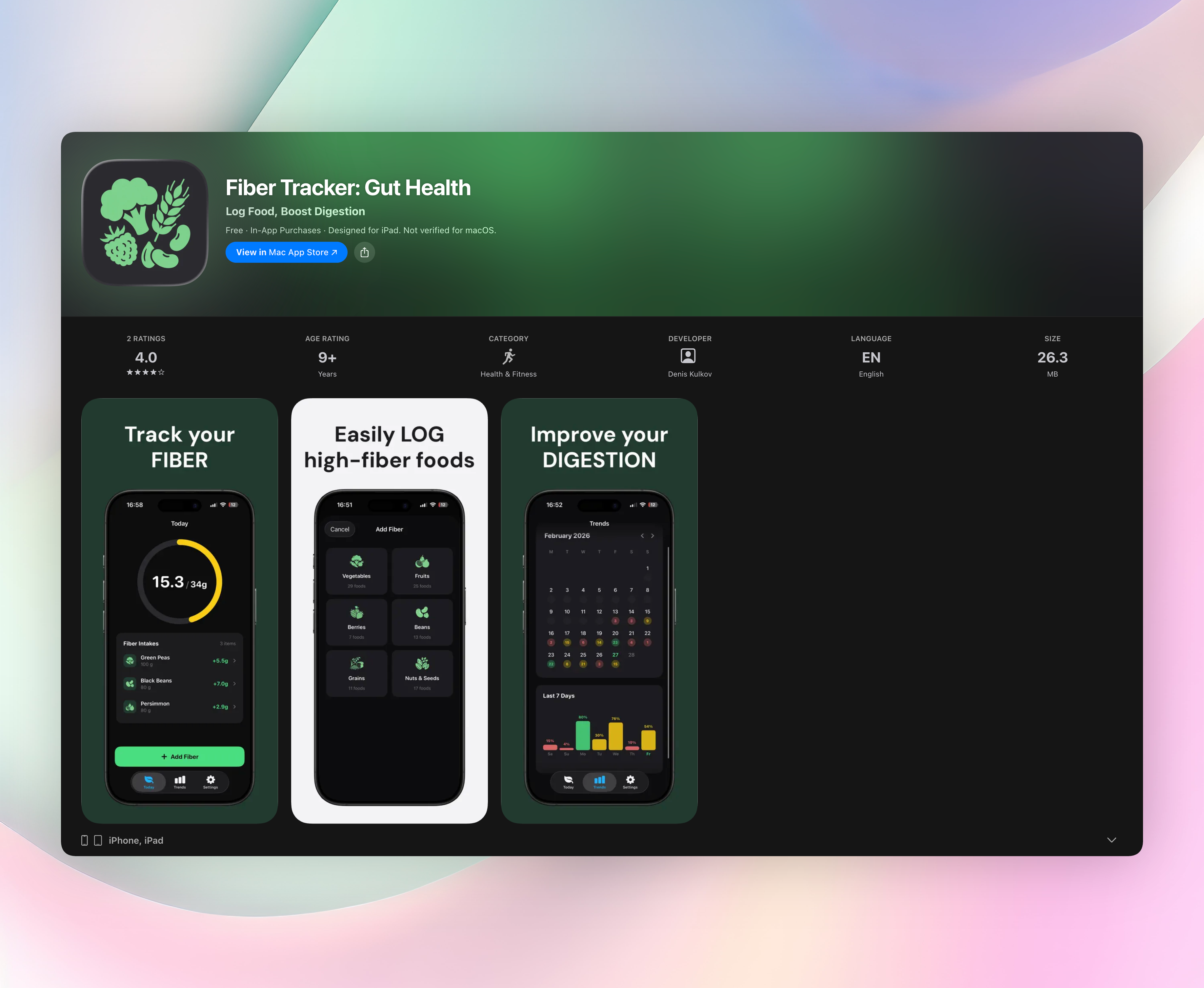
Fiber Tracker closes the gap between what you eat and what your gut actually needs. It’s the only app on this list built purely around a daily fiber target, with zero distractions. You set your goal based on gender and age, search a clean database to log foods, and see your progress as a bright, instantly readable ring. A weekly calendar shows your streak, and everything stays on your device, no sign‑ups, data collection, or ads. Because it’s iOS‑only, the interface feels native and responsive during quick meal logging.
Standout features:
- Instant logging with a searchable food database
- Clean progress ring that makes hitting your goal immediately obvious
- Weekly streak calendar to reinforce consistency
- Fully offline, no account ever required
Get Fiber Tracker · Fiber Tracker on the App Store
2. Fiber Counter
Best for: Android users who want a straightforward fiber database with no extras.
If you just want the fiber count for common US foods, Fiber Counter gives you that without macros or calories crowding the screen. It pulls from a USA foods database and shows fiber cleanly. The app is a fiber diary, nothing else: no meal photos, macro charts, or upsells. If your only goal is hitting a daily fiber number and you need a light Android tool, this is a solid pick.
3. Fiber Tracker | Plant Power
Best for: people aiming for plant diversity while tracking fiber.
Plant Power ties fiber intake directly to gut health by encouraging 30 different plants per week. You log fruits, vegetables, and legumes, and the app counts both your fiber grams and your plant variety score. The weekly goal creates a motivating rhythm that pure number tracking sometimes misses. It’s iOS‑only, stays focused on real foods, and works well if you want your fiber counter to nudge you toward a broader range of plants.
4. Fiber Tracker: Fibey
Best for: iOS users who want a fast log with a home screen widget.
Fibey keeps fiber tracking minimal. The free version lets you set a daily target and tap in grams manually, while the pro tier adds food search and a handy home screen widget. The widget is the standout, showing your ring progress without opening the app, so you can glance at your status. Fibey never tries to be a full diet tracker, so it’s a light pick if you just want to see your fiber status fast.
5. Fiber Tracker
Best for: Android users who want a tracker built around digestibility.
Developed by The CodeIt, this Android app frames fiber consumption as a daily gut‑health practice. You log meals and see progress bars that keep digestion front of mind. There’s no nutrient overflow or social features, just a simple monitor that shows whether you’re on track. The straightforward visuals reward consistency, making it a quiet but effective choice for anyone prioritizing digestive wellness.
6. Nutrition Tracker: Foodnoms
Best for: iOS users who want privacy‑first nutrition tracking with customizable fiber goals.
Foodnoms takes a broader approach while keeping fiber fully customizable. You can set distinct targets for fiber, protein, and hydration, and log foods via a barcode scanner or a clean manual entry screen. What sets it apart is privacy: you don’t need an account, and data lives only on your device. If you want a multi‑nutrient tracker that still lets you push fiber to the top of your dashboard, Foodnoms strikes a rare balance.
7. Dietary Fiber Tracker Counter
Best for: Android users who also want to track water and supplements alongside fiber.
This Android app goes a step beyond fiber by folding in water intake and supplement logging. Daily progress charts and a customizable fiber target help you spot trends, and the supplement feature keeps your whole digestive routine in one place. The graphs are insightful without being overwhelming, making it a good fit if you want a light‑touch wellness hub rather than a single‑metric counter.
8. Cronometer
Best for: detail‑oriented users who want micronutrient deep‑dives alongside fiber.
Cronometer tracks 84 nutrients accurately, including fiber. It’s popular with people who want to see exactly what’s in their food, right down to individual amino acids and vitamins. The free tier lets you log fiber without restrictions and gives you a comprehensive daily report. If you enjoy deep nutrition data and don’t mind a slightly busier interface, Cronometer is hard to beat.
9. MyNetDiary
Best for: iOS users who want AI‑assisted logging with a massive food database.
MyNetDiary balances calorie tracking with clear fiber insights. The AI meal scanner speeds things up by recognizing foods from photos or descriptions, and the verified database makes logging packaged and restaurant meals easy. Fiber tracking is built in, so you can watch your daily fiber bar fill while staying on top of overall nutrition. It’s a great option if you want guided, fast logging without losing track of fiber.
How we picked these apps
We looked for mobile apps that focus on dietary fiber tracking or have standout fiber features inside a broader nutrition tool. Each app was tested for at least three days of real meal logging, judging speed, accuracy, and how annoying the experience became by day three. We prioritized apps with clean, low‑ad interfaces and food databases that felt reliable in daily use. The list covers both iOS and Android, so you’ll find a tool no matter your platform. We also favored apps that don’t lock basic fiber counting behind a subscription. Most here let you track daily fiber for free. Fiber Tracker: Gut Health got the top spot because it does one thing without fluff: private fiber logging that takes seconds, with no nagging about calories, macros, or a premium upgrade.
Frequently asked questions
What should I look for in a dietary fiber tracker?
Look for simplicity first: an app you’ll actually open after every meal. A reliable food database and a custom daily goal are the other must‑haves. If the interface adds friction or pushes unrelated metrics, you’re less likely to stick with it.
Are these apps just for people with digestive issues?
Not at all. Anyone can benefit from hitting the daily fiber recommendation, which most people miss. Better fiber intake supports steady energy and heart health, so a tracker is useful even if you have no digestive complaints.
Do these counters show soluble vs. insoluble fiber?
Most dedicated fiber apps don’t break fiber into soluble and insoluble subtypes; they count total fiber grams. Broader trackers like Cronometer get closer by pulling detailed nutrient data, but even they often lack that split for every food. If that distinction is important to you, check Cronometer’s database depth.
Do I need a dedicated fiber app or will a general nutrition app work?
A dedicated fiber app removes noise so you can focus on one number. General nutrition apps work if you’re already logging full meals and can put fiber front and center on your dashboard, but the extra steps can feel heavy. Pick the focused tool for a lighter, stickier habit; choose the broader tracker if you want the full nutritional picture alongside fiber.
Why is Fiber Tracker: Gut Health listed first?
It’s the only app we tested that needs no login, collects no personal data, and tracks nothing but fiber. That single‑purpose design removes every barrier to daily logging. Open it, log, and see your progress without wading through calorie totals or freemium pop‑ups.
Can I use these apps without a subscription?
Yes. Several options, including Fiber Tracker: Gut Health and Fiber Counter, are completely free with no paywalls. Others like Fibey, Cronometer, and MyNetDiary offer free tiers that cover basic fiber counting, while premium features are optional. You can build a daily fiber habit without spending a thing.
The verdict
Fibey, Cronometer, and MyNetDiary all handle fiber well, but Fiber Tracker: Gut Health wins for pure, distraction‑free fiber logging. Its refusal to add calories, accounts, or ads makes daily tracking feel effortless, and that’s why it sticks. If you want the fastest way to close the fiber gap with no extra noise, it’s the app to beat. Get Fiber Tracker
Free Fiber tools
- Bristol Stool ChartCompare your stool with the seven-point Bristol bowel movement chart to see what the form indicates about gut transit time and general dietary levers.
- Carrot Fiber CalculatorEstimate the fiber in carrots by entering an amount, carrot size or weight, and whether they are raw or cooked.
- Daily Fiber CalculatorEstimate how much fiber each day fits your age, sex and life stage. See the personal target beside the FDA Daily Value used on nutrition labels.
- Fiber for Weight Loss CalculatorUse your calorie target or estimate one from your body measurements and activity. Get a daily fiber target and a gradual ramp-up schedule.
- Fruit Fiber ChartChoose a fruit, enter its serving size and compare fiber grams with other fruits from the same list.
- Fiber Ramp-Up PlannerWondering how much is too much fiber? Enter your current and target intake to get a week-by-week ramp-up schedule with matching fluid context.
- High Fiber Foods ChartUse this high-fiber foods chart for constipation to compare plant foods by category and sort them by fiber per 100 g or typical serving.
- High-Fiber Meal Plan BuilderChoose a daily fiber target, number of meals and food preference to create a one-day combination with fiber per meal and progress toward your target.
- Prune and Prune Juice Fiber CalculatorEstimate how much fiber and approximate sorbitol you get from prunes or prune juice, including how much prune juice for constipation questions may miss: juice has much less fiber than whole prunes.
- Soluble vs Insoluble Fiber ChartCompare soluble and insoluble fiber values by food and serving size for Fiber Tracker logging.
- Sweet Potato Fiber CalculatorEstimate how much fiber in a sweet potato based on its weight, cooking method and whether you eat the skin. See fibre, calories, carbs and daily target share.