Best 9 Fiber Ace Alternatives in 2026: Your Gut Health Match
Introduction
Fiber Tracker: Gut Health is our favorite Fiber Ace alternative because it keeps your data private and skips the login. We tested nine dedicated fiber apps for iOS and Android that ignore calorie counting entirely. Whether you prefer barcode scanning, plant diversity tracking, or a simple tap-to-tally tool, you’ll find a clean match for your logging style here.
Quick comparison table
| App | Best for | Platform | Price | Standout feature |
|---|---|---|---|---|
| Fiber Tracker: Gut Health | Privacy-first fiber tracking | iOS | Free | Offline only, no account setup |
| FiberUp | Barcode scanning, pure fiber count | iOS | Free | Daily progress ring with scanner |
| Dietary Fiber Tracker Counter | Charts and customizable goals | Android | Free | Custom daily targets, water/weight logs |
| Plant Power | Gut microbiome diversity | iOS | Free | Tracks 30+ plant species weekly |
| Proto | Photo/voice meal logging | iOS | Freemium | Instant nutrient breakdown from snaps |
| Fiber Counter | Simple tallying using USA food data | Android | Free | Straightforward daily fiber total |
| Fiber Tracker: Fibey | Minimal daily calculator | iOS | Free | Clean interface, no extras |
| Grove ◦ Fiber Tracker | Fiber and plant diversity | iOS | Free | Gut health log with habit building |
| Fiber Tracker (Android) | Basic meal logging | Android | Free | Simple digestion-focused logging |
| Every app on this list is a pure fiber tracker. No calorie logs, no macro clutter, so the table helps you zero in fast. |
1. Fiber Tracker: Gut Health
Best for: Privacy-first users who want nothing but fiber tracking.
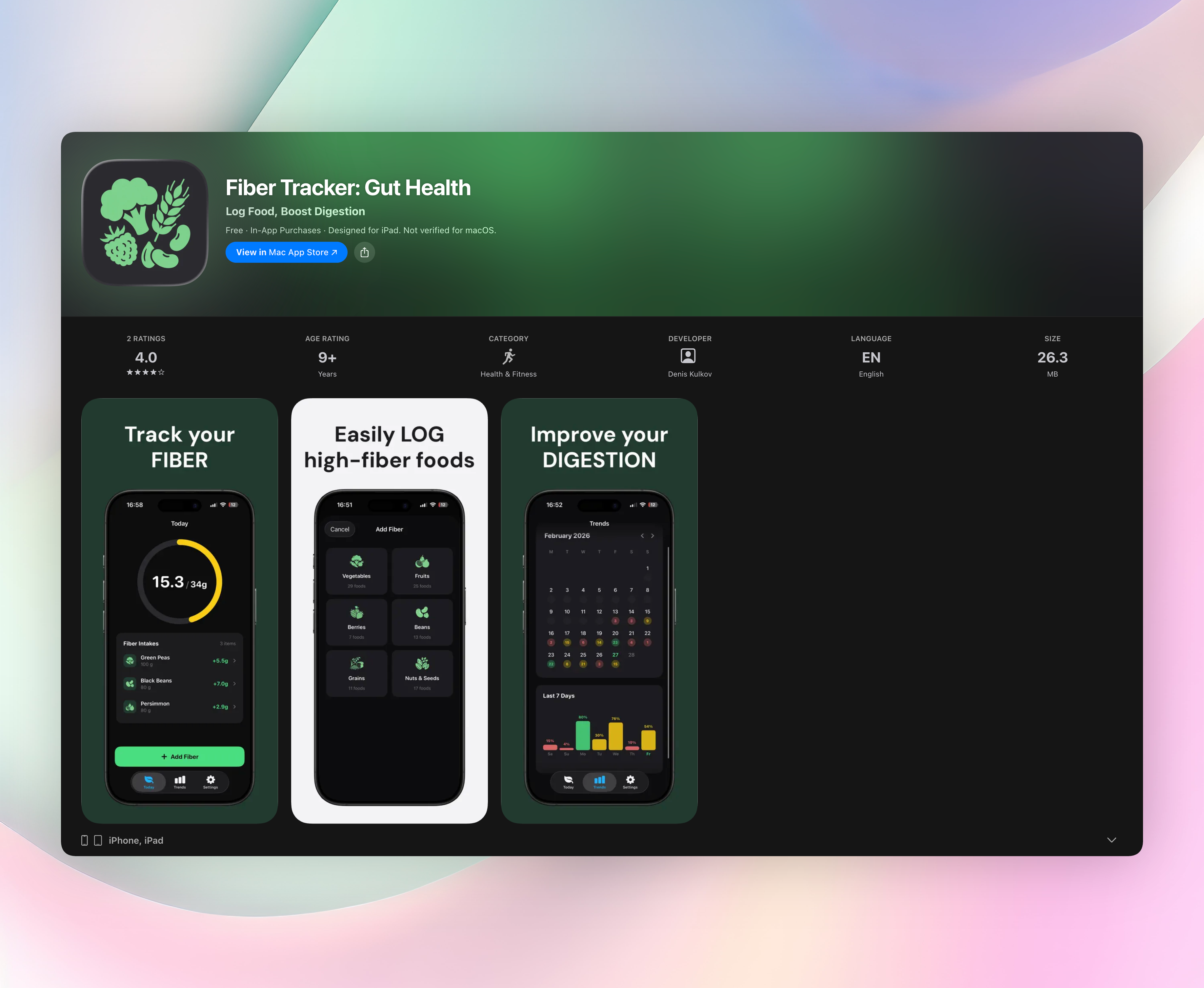
Fiber Tracker strips fiber logging down to its core. The interface asks only for grams of fiber per meal. No calorie database, no sign-ups. All your data lives on your device, never on a server, so your eating habits stay private.
- Set a daily fiber target based on your gender and age
- Search and log foods in seconds using a built-in database
- See your progress on a clean ring and weekly streak calendar
- Completely offline: no accounts, no ads, no data collection
It closes the gap between what you eat and the 25–38g you need. Gentle reminders nudge you without nagging. Because it ignores unrelated nutrition metrics, daily logging takes less than a minute. This is our top recommendation for anyone moving away from Fiber Ace, and the only app we link to directly. Get Fiber Tracker or install from the Fiber Tracker on the App Store. (iOS only.)
2. FiberUp
Best for: Barcode scanning and a pure fiber count.
If you eat a lot of packaged foods, FiberUp’s scanner pulls fiber grams straight from the label. No digging through menus required. The app centers on a daily progress ring that shows how close you are to your goal. There’s no calorie tracking, no macro breakdown. Just the fiber number you actually care about. The barcode feature shines at the grocery store or during meal prep, and the simplicity makes logging several times a day feel effortless. iOS only.
3. Dietary Fiber Tracker Counter
Best for: Android users who like charts and customizable goals.
This Android-only app goes beyond a simple tally by letting you set your own daily fiber target. It logs fiber, water, and weight, then serves up progress charts so you can spot trends. If visual feedback keeps you motivated and you like adjusting goals as your diet changes, it’s a solid pick. No barcode gimmicks, just clean logging and graphs that keep you accountable.
4. Plant Power
Best for: Anyone interested in gut microbiome diversity through plant variety.
Plant Power tracks the number of different plant species you eat, not just grams of fiber. The goal is 30+ types per week to feed a diverse gut microbiome. By focusing on color and variety, it pushes you toward a more colorful plate and keeps a running tally of which plant groups you’ve hit. No calorie counting. Just a plant checklist that turns eating for gut health into a fun challenge. iOS only.
5. Proto
Best for: Photo-and-voice logging fans who want instant nutrient breakdowns.
Snap a meal photo or describe it by voice, and Proto analyzes protein and fiber content on the spot. The freemium model gives you basic functions free, with premium options for deeper insights. It saves you from manually searching databases, which is handy when you’re eating mixed dishes. The AI often identifies common foods quickly, making logging faster than any manual entry. iOS only.
6. Fiber Counter
Best for: Simple tallying using USA food data.
Developed by Katie Larking, this Android app does one thing: adds up fiber grams from a database of American foods. You search or browse, log a portion, and see a running daily total. No charts, no streaks, just the number you need. It’s refreshingly basic, so you’ll spend less time learning the app and more time hitting your fiber goal. If you want a digital scorekeeper that never distracts, this is it.
7. Fiber Tracker: Fibey
Best for: A minimal daily calculator for iOS.
Fibey is a straightforward counter that focuses exclusively on dietary fiber. You tap in your intake and monitor your total over the day. The clean interface skips goal-setting gimmicks and social features. It’s just a digital tally to keep you honest. Perfect if you prefer to track manually without trusting a food database, and unapologetically bare-bones. iOS only.
8. Grove ◦ Fiber Tracker
Best for: A gut health log that tracks both fiber and plant diversity.
Grove monitors your daily fiber grams and plant food variety, then shows your progress toward a healthier gut. You log meals and the app highlights which plant colors and groups you’ve covered. It’s built to help you build consistent habits, not just count numbers. If you want a more holistic gut-health tool on iOS, this one goes beyond plain fiber counting. The focus on plant diversity encourages a diet pattern that supports long-term digestion.
9. Fiber Tracker (Android)
Best for: Basic meal logging on Android for improved digestion.
This app by The CodeIt lets you log meals and see total fiber consumption with minimal setup. No frills, no social feeds. It’s just a daily diary that aims to support better digestion and a balanced diet. If you’re on Android and need a lightweight logger that won’t bog you down with ads or subscriptions, it’s worth a look. The plain but functional interface keeps you focused on your fiber goal.
How we picked these apps
We scoured app stores for trackers that put fiber first, just like Fiber Ace does. Any app that forced a calorie diary, demanded a login to start, or hid fiber tracking behind a paywall was disqualified. We prioritized apps that:
- Save your data locally whenever possible
- Require minimal taps to log a meal
- Give you a clear daily target without drowning you in charts
- Cover both iOS and Android so you have options We didn’t consider all-in-one diet apps because they add friction when you only want to boost fiber. Each pick on this list is a pure fiber tracker, tested for real-world ease of use. We also avoided apps that push subscriptions before you can log a single fiber gram.
Frequently asked questions
Is a dedicated fiber tracker better than a general food diary?
General food diaries ask you to log every macro and ingredient, which gets tiresome if you’re only focused on fiber. A dedicated fiber app lets you log just fiber grams, often with a searchable database tailored to high-fiber foods. That stripped-down approach cuts decision fatigue and makes you far more likely to stick with daily tracking. If complete nutrition trackers have overwhelmed you, switching to a fiber-only tool feels immediately lighter.
How accurate are these apps without barcode scanning?
Most apps pull from USDA or branded databases that are reliable for common whole foods and packaged items. Barcode scanning adds speed but doesn’t guarantee better accuracy. It simply reads the label’s data, which you could enter manually. For precise tracking, cross-check a database entry with the nutrition label or weigh your portions. The built-in databases are generally close enough for everyday use.
Can tracking fiber really improve gut health?
Yes. Consistently hitting the recommended 25–38 grams per day supports regular digestion, feeds beneficial gut bacteria, and can reduce bloating over time. Tracking helps you see the gap between your typical intake and the goal, then increase gradually. Apps like Fiber Tracker and Plant Power let you up your fiber without shocking your system, which is key for avoiding discomfort. Even a few extra grams a day can make a noticeable difference.
The verdict
If you’re hunting for Fiber Ace alternatives that respect your privacy and make daily fiber tracking dead simple, Fiber Tracker: Gut Health is the one to beat. No account, no calorie clutter, and all data stays on your iPhone. We link to it directly because it’s genuinely the cleanest option in this category: zero friction from sign-up to first log. Get Fiber Tracker and start closing your fiber gap today.
Free Fiber tools
- Bristol Stool ChartCompare your stool with the seven-point Bristol bowel movement chart to see what the form indicates about gut transit time and general dietary levers.
- Carrot Fiber CalculatorEstimate the fiber in carrots by entering an amount, carrot size or weight, and whether they are raw or cooked.
- Daily Fiber CalculatorEstimate how much fiber each day fits your age, sex and life stage. See the personal target beside the FDA Daily Value used on nutrition labels.
- Fiber for Weight Loss CalculatorUse your calorie target or estimate one from your body measurements and activity. Get a daily fiber target and a gradual ramp-up schedule.
- Fruit Fiber ChartChoose a fruit, enter its serving size and compare fiber grams with other fruits from the same list.
- Fiber Ramp-Up PlannerWondering how much is too much fiber? Enter your current and target intake to get a week-by-week ramp-up schedule with matching fluid context.
- High Fiber Foods ChartUse this high-fiber foods chart for constipation to compare plant foods by category and sort them by fiber per 100 g or typical serving.
- High-Fiber Meal Plan BuilderChoose a daily fiber target, number of meals and food preference to create a one-day combination with fiber per meal and progress toward your target.
- Prune and Prune Juice Fiber CalculatorEstimate how much fiber and approximate sorbitol you get from prunes or prune juice, including how much prune juice for constipation questions may miss: juice has much less fiber than whole prunes.
- Soluble vs Insoluble Fiber ChartCompare soluble and insoluble fiber values by food and serving size for Fiber Tracker logging.
- Sweet Potato Fiber CalculatorEstimate how much fiber in a sweet potato based on its weight, cooking method and whether you eat the skin. See fibre, calories, carbs and daily target share.