
Best 9 Fiber Maxing Alternatives in 2026: Apps to Hit Your Fiber Goals
Introduction
Fiber Tracker is the best app for closing your daily fiber gap. It’s the clearest pick among fiber maxing alternatives. This list compares focused fiber trackers and full nutrition apps that excel at fiber logging, so you can find the right tool without guesswork.
Quick comparison table
| App | Platform | Standout Feature | Best For | Price |
|---|---|---|---|---|
| Fiber Tracker | iOS | Gentle ramp-up algorithm | Pure fiber maxing without distractions | Paid |
| MyFitnessPal | iOS, Android | Massive barcode database | Fast logging inside a familiar calorie counter | Freemium |
| Cronometer | Android, iOS, Web | Soluble & insoluble fiber breakdown | Micronutrient nerds who want fiber precision | Freemium |
| Cara Care | iOS | Symptom-timeline overlay | IBS/FODMAP management while tracking fiber | Freemium |
| Bowelle | iOS | One-tap Bristol scale logging | Minimalist digestion pattern spotting | Paid |
| YAZIO | Android, iOS | Fasting timer + high-fiber meal planner | Intermittent fasters maxing fiber in a window | Freemium |
| MyNetDiary | iOS, Android | Daily target feedback messages | People who thrive on specific fiber nudges | Freemium |
| Lose It! | Android, iOS | Patterns linking fiber to lower calorie days | Calorie-conscious users adding fiber goals | Freemium (fiber in premium) |
| Calorie Counter by FatSecret | Android, iOS | Weekly fiber averages alongside weight | Completely free fiber tracking with no paywalls | Free |
1. Fiber Tracker
Best for: Pure fiber maxing without calorie clutter, social feeds, or sign-up friction.
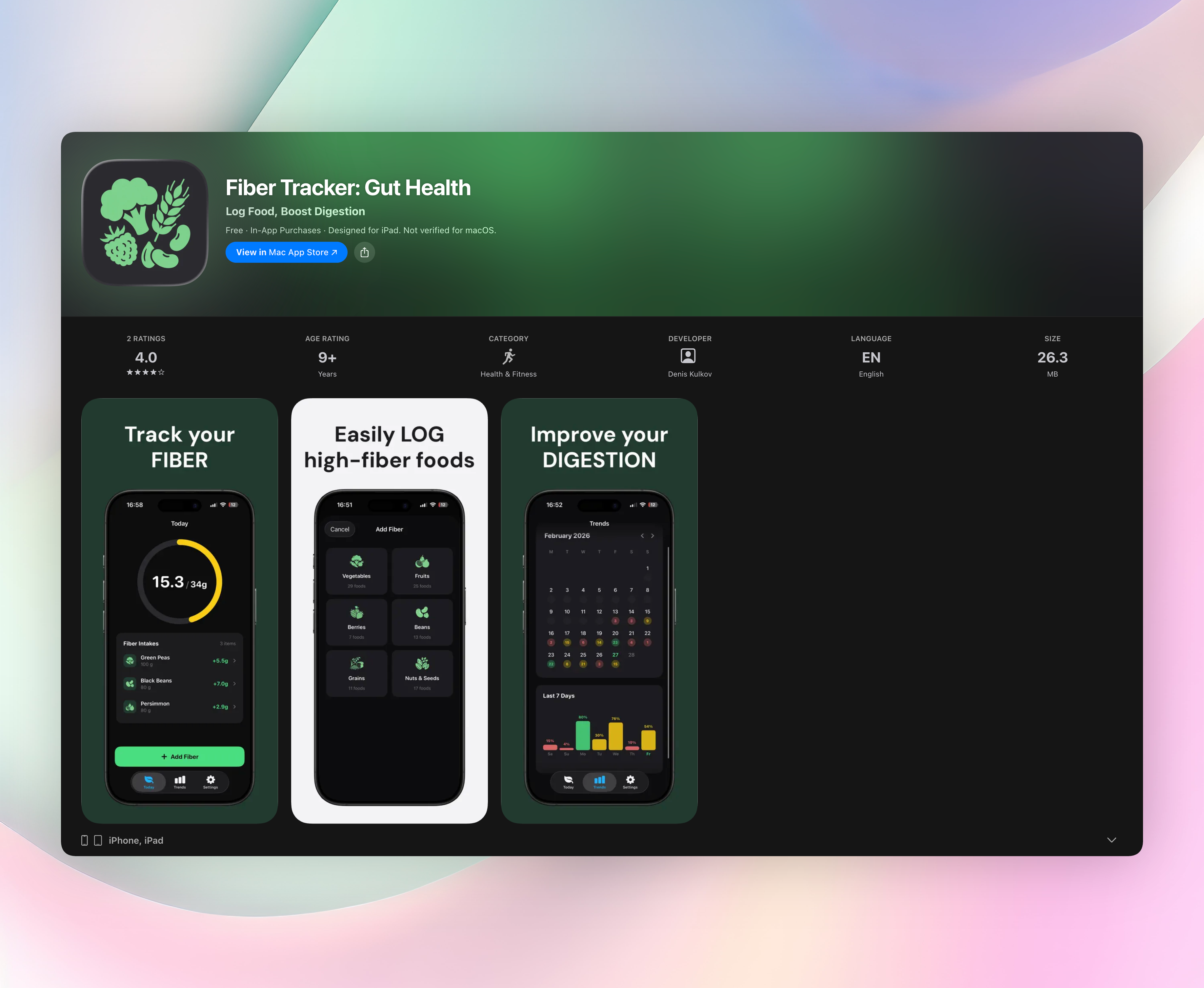
Fiber Tracker puts a single metric front and center: your daily fiber progress. Set a personalized target based on age and gender, log meals with a quick search, and watch the clean progress ring fill up. Everything runs privately on your device—no account, no data collection, no ads.
The standout feature is a built-in ramp-up algorithm. Instead of jumping from 10g to 40g and dealing with bloating, the app gently increases your daily goal so your gut adapts. That’s something no calorie-counter does well.
- Dead-simple fiber ring updates after each log
- Weekly streak calendar to build consistency
- Fully private by design—your data never leaves your phone
- iOS only; the one tool here purpose-built for fiber maxing
You can Get Fiber Tracker or grab it directly on the App Store. When fiber is the only number you care about, this single-minded approach beats hunting through crowded nutrition dashboards.
2. MyFitnessPal
Best for: People already using MyFitnessPal for calorie counting who want reliable fiber tracking inside a familiar interface.
Its huge barcode database makes logging fiber almost effortless. Fiber sits inside the “nutrients” tab, not on the home screen, so you’ll need an extra tap, but the data is solid. The real timesaver is copying entire meals from previous days. That quickly builds a fiber log without re-entering your go-to high-fiber breakfasts or snacks.
3. Cronometer
Best for: Data nerds who want exact fiber breakdowns alongside 80+ micronutrients.
Cronometer leans on lab-verified entries, so numbers for total fiber, soluble fiber, and insoluble fiber are unusually precise. The carbohydrate breakdown chart separates fiber from sugars and starch in one glance, helpful if you’re balancing different fiber types. Available on web, Android, and iOS, the free tier shows full nutrient profiles. It’s a strong pick if you are willing to dig a little.
4. Cara Care
Best for: Managing IBS or following a low-FODMAP diet while carefully reintroducing fiber.
Cara Care logs meals, symptoms, and bowel movements together so you see fiber’s direct digestive impact. It was designed with gastroenterologist input, so the link between what you eat and how you feel gets real attention. The visual timeline overlays fiber intake with symptom severity, turning guesswork into obvious patterns, especially useful when you are testing high-fiber foods one by one.
5. Bowelle
Best for: A minimalist, no-stress way to watch how fiber changes your digestion.
Bowelle skips deep nutrition databases and focuses on a visual grid for stool consistency, water intake, and food notes. Logging a bowel movement takes one tap on the Bristol scale, and you can cross-reference it with recent high-fiber meals instantly. It’s iOS-only and deliberately simple, so you spot patterns without drowning in data.
6. YAZIO
Best for: Intermittent fasters who want to max fiber within their eating window.
YAZIO’s nutrition breakdown shows fiber clearly per meal and per day, and custom fiber goals are available even in the free plan. The fasting timer plus meal planner helps you schedule high-fiber meals around your fasts, so you stay full and hit targets. Android-focused but also on iOS, it’s a practical hybrid for anyone balancing time-restricted eating with gut health.
7. MyNetDiary
Best for: Anyone who thrives on specific daily targets and encouraging nudges.
You set a daily fiber goal, and each day the app delivers a straightforward “Did you hit it?” score along with nutrition charts that highlight fiber trends. The standout touch is daily feedback messages: they praise you when you meet goals or suggest easy swaps like adding chia seeds or lentils. Beginner-friendly and available on iOS and Android.
8. Lose It!
Best for: Calorie-conscious users who want fiber goals layered into a weight-loss plan.
Fiber tracking isn’t front and center; it lives behind the premium subscription inside custom nutrient goals. Once enabled, the barcode scanner and large food database keep logging practical. The “patterns” section reveals how high-fiber days correlate with lower overall calorie intake, which is exactly the kind of motivation that helps you stick with both goals.
9. Calorie Counter by FatSecret
Best for: A completely free, no-nonsense option that still surfaces a dedicated fiber readout.
The carbohydrate breakdown section calls out dietary fiber separately, making it scannable at a glance. Android-focused but also on iOS, it’s backed by a surprisingly active user community. The ability to view weekly fiber averages alongside weight gives you a clear picture of long-term consistency without ever hitting a paywall.
How we picked these apps
We tested each app by logging identical high-fiber days to compare accuracy, friction, and how much tapping it took to find the fiber number. Apps that buried fiber two or three menus deep were cut. We prioritized tools that show a clear, customizable fiber target, not just a generic percent of a daily value. We included dedicated gut-health trackers and mainstream calorie apps that handle fiber well, so you get options for every logging style. If a premium feature unlocks fiber tracking, we noted it plainly.
Frequently asked questions
What does “fiber maxing” actually mean?
Fiber maxing is the intentional effort to hit 30–40+ grams of dietary fiber daily for gut health, satiety, and metabolic benefits. It’s common in biohacking and gut-repair circles. Tracking removes the guesswork from “eat more plants.”
Why not just use a general calorie app for fiber?
General apps lump fiber into a long nutrient list, making daily monitoring feel like a chore. Dedicated fiber or gut-health apps keep the metric front and center, so you’re more likely to act on it. Hybrid apps like Cronometer still work if you’re willing to dig.
How fast should I increase my fiber intake?
Jumping from 10g to 40g overnight causes bloating and discomfort. Increase by about 5g every few days and track symptoms alongside intake. Fiber Tracker’s gradual ramp-up handles that safety net automatically.
The verdict: Fiber Tracker is the best fiber maxing tool
Fiber Tracker wins because it does one job exceptionally well: closing the gap between what you eat and what your gut needs. No calorie counters, no social feeds, no sign-up friction. Just a private progress ring that makes daily logging effortless. It’s the only app on this list purpose-built for fiber maxing, not adapted to it. Stop guessing and start logging with the tool that makes it obvious every day: Get Fiber Tracker.
Free Fiber tools
- Bristol Stool ChartCompare your stool with the seven-point Bristol bowel movement chart to see what the form indicates about gut transit time and general dietary levers.
- Carrot Fiber CalculatorEstimate the fiber in carrots by entering an amount, carrot size or weight, and whether they are raw or cooked.
- Daily Fiber CalculatorEstimate how much fiber each day fits your age, sex and life stage. See the personal target beside the FDA Daily Value used on nutrition labels.
- Fiber for Weight Loss CalculatorUse your calorie target or estimate one from your body measurements and activity. Get a daily fiber target and a gradual ramp-up schedule.
- Fruit Fiber ChartChoose a fruit, enter its serving size and compare fiber grams with other fruits from the same list.
- Fiber Ramp-Up PlannerWondering how much is too much fiber? Enter your current and target intake to get a week-by-week ramp-up schedule with matching fluid context.
- High Fiber Foods ChartUse this high-fiber foods chart for constipation to compare plant foods by category and sort them by fiber per 100 g or typical serving.
- High-Fiber Meal Plan BuilderChoose a daily fiber target, number of meals and food preference to create a one-day combination with fiber per meal and progress toward your target.
- Prune and Prune Juice Fiber CalculatorEstimate how much fiber and approximate sorbitol you get from prunes or prune juice, including how much prune juice for constipation questions may miss: juice has much less fiber than whole prunes.
- Soluble vs Insoluble Fiber ChartCompare soluble and insoluble fiber values by food and serving size for Fiber Tracker logging.
- Sweet Potato Fiber CalculatorEstimate how much fiber in a sweet potato based on its weight, cooking method and whether you eat the skin. See fibre, calories, carbs and daily target share.