Best 9 Bowelle Alternatives in 2026: Apps to Log Symptoms & Triggers
Introduction
Fiber Tracker is the best Bowelle alternative for simple, private fiber tracking without the noise. Below are 9 solid Bowelle alternatives for different digestive tracking needs, from hypnotherapy to AI food diaries. We tested every pick hands-on to save you trial-and-error time.
Quick comparison table
| App | Best for | Platforms | Standout feature |
|---|---|---|---|
| Fiber Tracker | Closing the fiber gap quickly | iOS | Dead-simple daily fiber target bar |
| myIBS | Doctor-ready IBS journaling | iOS, Android | Appointment-friendly PDF reports |
| Plop | Visual stool logging & FODMAP tracking | iOS, Android | Glanceable Bristol color-coded timeline |
| FoodLog | AI-powered food intolerance detection | Android | Intolerance probability score |
| Bearable | Custom symptom & trigger correlation | iOS, Android | Factor-plotting insight graphs |
| Balloon | Fiber accountability for constipation | iOS, Android | Daily fiber score grade |
| Cara Care | Science-backed IBS food reintroduction | iOS, Android | Guided food reintroduction algorithm |
| mySymptoms | Raw data symptom-meal discovery | iOS, Android | Meal-ingredient breakdown mapping |
| Nerva | Gut-brain hypnotherapy for IBS | iOS, Android | 6-week psychogastroenterology program |
1. Fiber Tracker
Best for: anyone who wants to close the fiber gap without a complicated food diary.
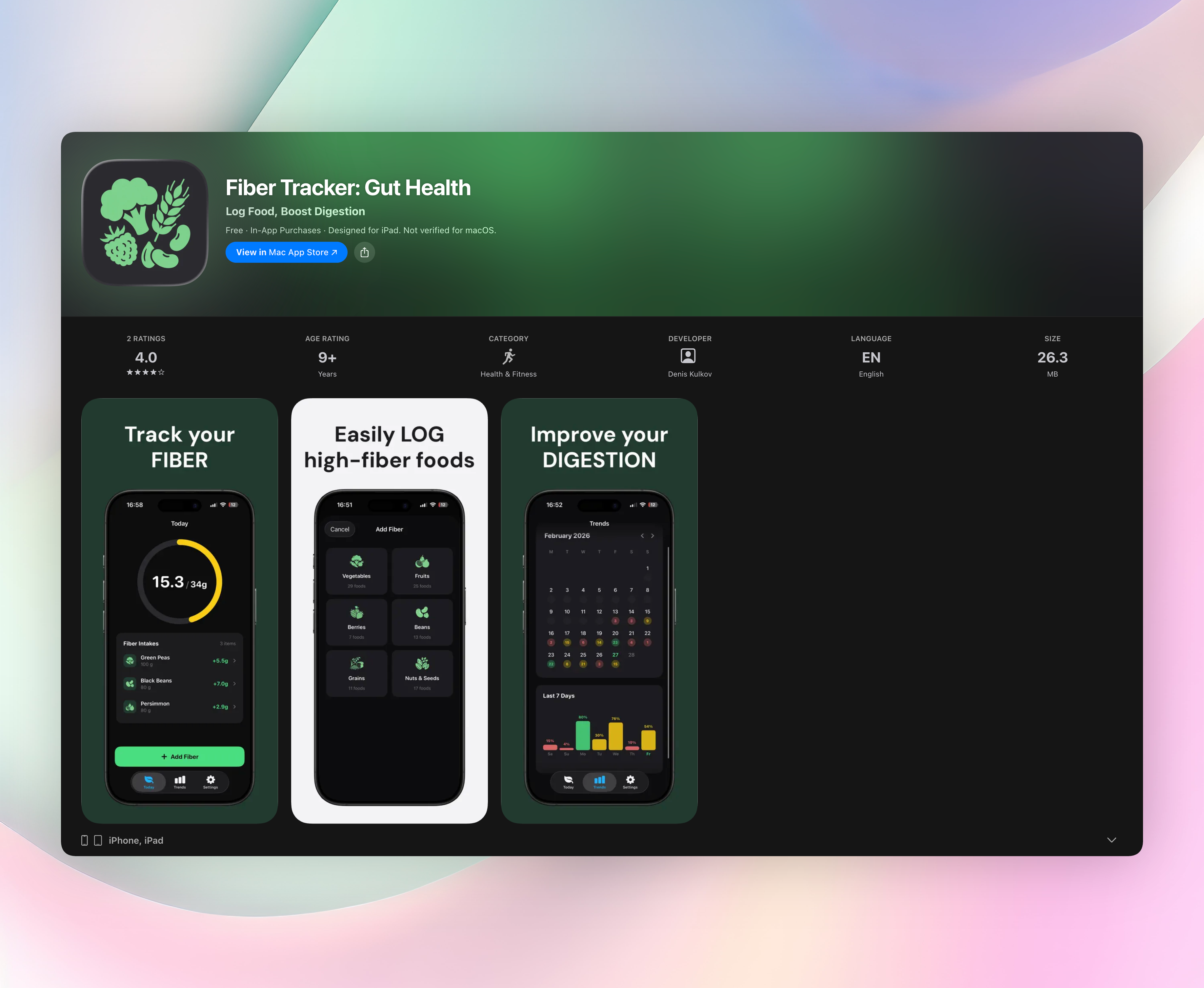
Fiber Tracker zeroes in on the single biggest dietary blind spot for gut health: actual grams of fiber eaten. There’s no account to create, no bloated feature set. You set a daily fiber target based on age and gender, log foods quickly from a searchable database, and watch a clean progress ring fill up. Hitting 30g feels like a game, not a chore. Privacy is a cornerstone: data stays on your device, never touches a server, and there are zero ads. It works offline, too, with entries taking under 10 seconds.
- Standout feature: the daily fiber target progress bar that makes consistent tracking effortless.
- Everything runs on-device. No accounts, no data collection.
- Offline support means you can log anytime, anywhere.
Get Fiber Tracker • Fiber Tracker on the App Store
2. myIBS
Best for: people who need a doctor-approved IBS journal to bring to appointments.
myIBS, backed by the Canadian Digestive Health Foundation, tracks symptoms, stool type, food, sleep, and stress in a single place. The real payoff is the built-in report generator: “My Report” turns messy daily logs into a sorted PDF a clinician can scan in minutes. It replaces handwritten notes with a clear, appointment-ready summary. If your goal is better communication with your GI doctor, this is the one.
3. Plop
Best for: visual trackers who want Bristol Stool Scale logging with FODMAP tools.
Plop turns bowel movement logging into a camera-roll-style timeline. You tag entries with conditions like IBS or Crohn’s and can run FODMAP elimination tracking alongside. The color-coded Bristol chart gives you a quick glanceable diary without digging through text. Shareable progress reports make it easy to hand data off to a dietitian or doctor without overcomplicating things.
4. FoodLog
Best for: people who suspect food intolerances and want AI to do the pattern-hunting.
FoodLog pairs a symptom journal with an artificial-intelligence engine built for elimination diets. Instead of forcing you to build a spreadsheet, it surfaces hidden connections between meals and flare-ups automatically. The intolerance probability score flags likely trigger foods as you log, so you don’t need to guess. It’s Android-only and especially useful when you’re just starting to identify what’s setting off your gut.
5. Bearable
Best for: custom health trackers who want every variable (mood, sleep, energy, meals) in one place.
Bearable uses a building-block approach. You decide what to track each day, then use the “insight” tab to plot symptoms against any factor you’ve logged. Chronic-condition communities lean on these correlation graphs to find non-obvious triggers. It won’t force a rigid digestive diary on you, but if you’re willing to set it up, the pattern discovery is among the best in the health tracker space.
6. Balloon
Best for: anyone fighting constipation and bloating who needs a fiber-logging accountability partner.
Balloon combines bowel movement logging with a fiber intake calculator. Long-term trend graphs show whether ramping up fiber is actually reducing bloating or just adding noise. The “fiber score” distills your daily intake into a simple grade, which helps you stay honest about your fiber goal. It’s built specifically for the constipation-and-bloating cycle rather than general gut health.
7. Cara Care
Best for: people who want a science-backed IBS companion with structured food reintroduction.
Cara Care organizes symptom and stool tracking around clinical gut-health protocols. Its educational library explains the why behind common triggers, which is rare among tracking apps. The standout is the guided food reintroduction algorithm: it prevents the common mistake of rushing elimination diet steps, making it safer to figure out which foods you truly tolerate long-term.
8. mySymptoms
Best for: data nerds willing to log extensively to uncover personal food-symptom correlations.
mySymptoms gives you an open-ended diary that captures meals, bowel movements, mood, and anything else you invent. Its strength lies in raw data export and the meal-ingredient breakdown, which maps specific ingredients to next-day symptoms across weeks of logging. You’ll need patience to log everything, but the payoff is a deeply personalized trigger map no AI guesswork can replicate.
9. Nerva
Best for: people curious about the gut-brain axis who find food tracking stressful.
Nerva skips food logs entirely. It delivers a 6-week program of gut-directed hypnotherapy audio sessions aimed at calming an overreactive gut. The protocol is clinically validated for IBS and leans on psychogastroenterology: visualization exercises that address the gut-brain connection directly. If meticulous tracking feels like part of the problem, this is your alternative.
How we picked these apps
We tested each app against a few non-negotiables: ease of first log, privacy stance, platform availability, and direct gut-health relevance. We cut anything that locked core features behind a paywall during the very first entry. General nutrition apps were avoided. We stuck to tools specifically built for digestive health. The list intentionally mixes philosophies, from structured logging to mind-body approaches, so you can match the tool to your comfort level.
Frequently asked questions
Is Fiber Tracker free?
Yes. The core fiber tracking (daily target, food logging, and progress ring) is completely free. No paywall blocks the basic daily counter.
Can I import my old Bowelle data?
Most alternatives lack a direct Bowelle import. Check each app’s export or CSV format; sometimes you can reformat old data manually, but there’s no automatic migration path.
Which app is best for sharing with a doctor?
myIBS and Plop generate appointment-ready reports. myIBS provides a clinician-friendly PDF, while Plop offers shareable progress reports with Bristol scale clarity.
Do any of these replace a dietitian?
No. These apps are tracking aids, not medical advice. Use them to gather data and spot patterns, but always involve a qualified professional for diagnosis or major dietary changes.
The verdict
Fiber Tracker is the best Bowelle alternative because it focuses relentlessly on the neglected fiber gap. While other apps chase broad symptom correlation, this one does a single job exceptionally well. For most people, consistent fiber tracking solves more problems than an elaborate diary ever will. If you want to close the gap with zero friction, start here.
Free Fiber tools
- Bristol Stool ChartCompare your stool with the seven-point Bristol bowel movement chart to see what the form indicates about gut transit time and general dietary levers.
- Carrot Fiber CalculatorEstimate the fiber in carrots by entering an amount, carrot size or weight, and whether they are raw or cooked.
- Daily Fiber CalculatorEstimate how much fiber each day fits your age, sex and life stage. See the personal target beside the FDA Daily Value used on nutrition labels.
- Fiber for Weight Loss CalculatorUse your calorie target or estimate one from your body measurements and activity. Get a daily fiber target and a gradual ramp-up schedule.
- Fruit Fiber ChartChoose a fruit, enter its serving size and compare fiber grams with other fruits from the same list.
- Fiber Ramp-Up PlannerWondering how much is too much fiber? Enter your current and target intake to get a week-by-week ramp-up schedule with matching fluid context.
- High Fiber Foods ChartUse this high-fiber foods chart for constipation to compare plant foods by category and sort them by fiber per 100 g or typical serving.
- High-Fiber Meal Plan BuilderChoose a daily fiber target, number of meals and food preference to create a one-day combination with fiber per meal and progress toward your target.
- Prune and Prune Juice Fiber CalculatorEstimate how much fiber and approximate sorbitol you get from prunes or prune juice, including how much prune juice for constipation questions may miss: juice has much less fiber than whole prunes.
- Soluble vs Insoluble Fiber ChartCompare soluble and insoluble fiber values by food and serving size for Fiber Tracker logging.
- Sweet Potato Fiber CalculatorEstimate how much fiber in a sweet potato based on its weight, cooking method and whether you eat the skin. See fibre, calories, carbs and daily target share.